
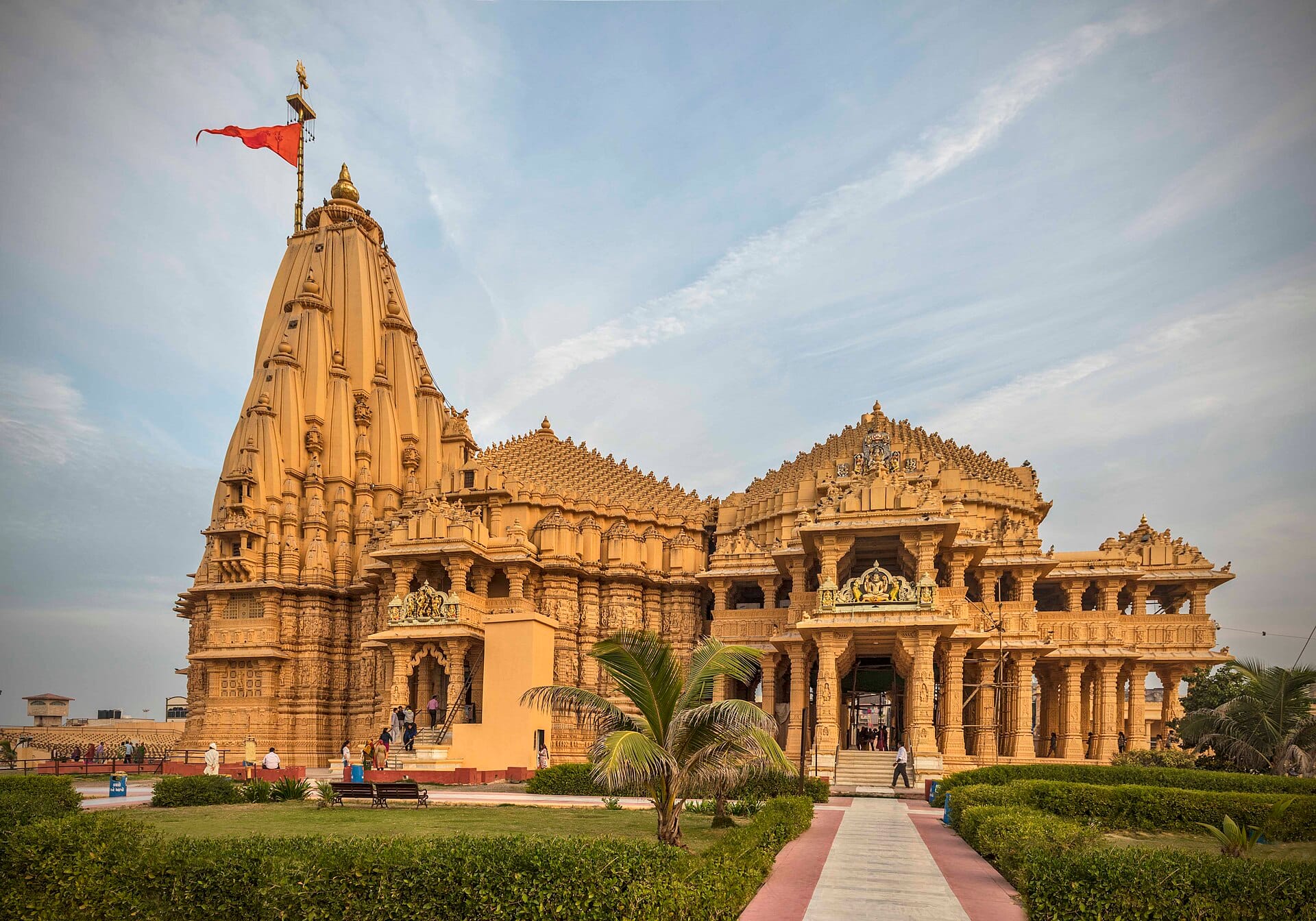
A wide-angle view – a bit distorted – from the southeast side of the present Somnath temple. Nataraja can be seen on the sukhanasi, along with the two-storey design. ( By B. SurajPatro1997 – Own work)
If you’re wondering, “is Somnath Temple wheelchair accessible?”, this guide will give you a clear and honest answer based on a real visit.
Visiting Somnath Temple was a deeply meaningful experience for me—not just spiritually, but also from an accessibility perspective.
I am a person living with Limb-Girdle Muscular Dystrophy (LGMD). I cannot climb stairs independently and can only walk very short distances. So accessibility is not a luxury for me—it’s a necessity.
In this article, I’ll share my real experience of wheelchair accessibility at Somnath Temple, including what works well, the challenges you should be prepared for, and practical tips to make your visit smoother.
Also Read : Wheelchair Accessibility At Nageshwar Temple Jyotirlinga, Dwarka
Table of Contents
Temple Timings & Key Information
- Temple Opening Hours: 6:00 AM to 10:00 PM
- Darshan Hours: 6:00 AM to 10:00 PM (continuous, with brief pauses during aarti or special rituals)
Aarti Timings:
- Mangala Aarti (Morning): 7:00 AM
- Rajbhog Aarti (Noon): 12:00 PM
- Sandhya Aarti (Evening): 7:00 PM
Light & Sound Show – “Jay Somnath”
- Timings: 8:00 PM to 9:00 PM
- Conducted daily (weather permitting)
- Nominal fee applies
👉 Tip: Plan your visit around aarti timings if you want a smoother wheelchair experience, as crowd movement changes during these periods.
For More Information you can check Somnath Temple Website
Main Access Experience (Important for Wheelchair Users)
We reached the temple in the evening after resting at our hotel.
Somnath Mandir has a large parking area, and there is a shuttle service provided by the temple trust. However, this shuttle is not wheelchair accessible, as it requires stepping into a high vehicle.
Because of this, we had to travel from the parking to the temple entrance on our own wheelchair, which is roughly 500 meters.
Additionally, even after reaching the main entrance, there is another 200–300 meters distance to the point where wheelchairs are available.
👉 Important practical advice:
- If you are coming by taxi or auto, get down directly at the temple entrance
- If using your own car, get dropped first and park later
- If you are not comfortable walking even short distances, carry your own wheelchair
This planning can make a huge difference in your overall experience.
Entry & Security Experience
There is a dedicated entry gate near the information center for wheelchair users and senior citizens.
- Wheelchairs are available at this point
- Only one attendant is allowed with the wheelchair user
- Others must go through the regular queue
We were guided through a separate, less crowded path, which made entry smooth and hassle-free.
Also Read : Dwarka Temple Wheelchair Accessibility Guide: Dwarkadhish & Bet Dwarka
Avoid Carrying Phones
One very important tip:
- Phones are not allowed inside the temple
- There is a long queue for depositing them
👉 Best option:
- Leave phones at your hotel
- Or keep them in your car
This can easily save 20–30 minutes.
Inside Access & Movement
Inside the temple complex, movement is mostly smooth and wheelchair-friendly.
- A lift is available to reach the main darshan level
- During aarti time, it may pause briefly due to crowd management
Overall, navigation inside the complex is manageable with some guidance from staff.
Final Accessibility Challenge (Near Sanctum)
The only major limitation comes right before the main deity:
- 3 steps up and 3 steps down
- Each step is quite high (~10–15 inches)
For someone like me, this is not possible independently.
We requested help, and within 15–20 minutes, security staff came and physically assisted by lifting the wheelchair across the steps.
They also helped while returning.
🙏 The staff was extremely cooperative and supportive.
What helped:
- Requested staff assistance
- Security team came and lifted the wheelchair safely
- Assistance provided during both entry and exit
Darshan Experience
Once inside, the experience was truly beautiful.
The distance from the steps to the main deity is very short, so after assistance, I was able to have a clear and peaceful darshan.
We visited in the evening, and the temple looked stunning with lighting. The crowd was also manageable, and the overall atmosphere was calm and divine.
Even our driver, who went through the regular queue, was able to complete darshan within 20–25 minutes, indicating that the crowd was not too heavy.
Where We Stayed
We stayed at The Bliss Hotel:
- Around 2 km from the temple
- Ramp available at entrance
- Wheelchair-friendly setup
- Helpful staff
- Budget-friendly
👉 A good option if you are travelling with accessibility needs.
Accessibility Summary
👍 What Works Well:
- Large and well-maintained campus
- Smooth pathways for wheelchair movement
- Dedicated entry for wheelchair users
- Lift access available
- Helpful and supportive staff
- Wheelchairs available at entry
👎 What Can Improve:
Distances between key points can be tiring
Shuttle service is not wheelchair-friendly
Final access requires manual assistance over steps
Also Read : Wheelchair Accessibility at Ujjain Mahakaleshwar Temple
Final Tips
- Get dropped directly at the temple entrance
- Carry your own wheelchair if needed
- Avoid carrying phones
- Keep buffer time for assistance near sanctum
- Choose a nearby accessible hotel
Also Read : Wheelchair Accessibility in Ayodhya: My Personal Experience as a Muscular Dystrophy Patient
Final Thoughts
Despite a few accessibility gaps, visiting Somnath Mandir was a very fulfilling and positive experience for me.
As someone who cannot climb stairs and can walk only short distances, I still felt supported throughout the journey.
With the right planning, Somnath Mandir is definitely accessible and worth visiting for wheelchair users.
Anshuli Singhal is a software engineer living with Limb Girdle Muscular Dystrophy (LGMD). She was diagnosed in her early adulthood and has firsthand experience managing the daily challenges of progressive muscle weakness. Through her writing on AdaptiveLifeGuide.com, she shares real-life insights to help patients and caregivers better understand muscular dystrophy and practical ways to adapt to everyday life.
This article is based on personal experience and is intended for informational purposes only. It does not replace professional medical advice.